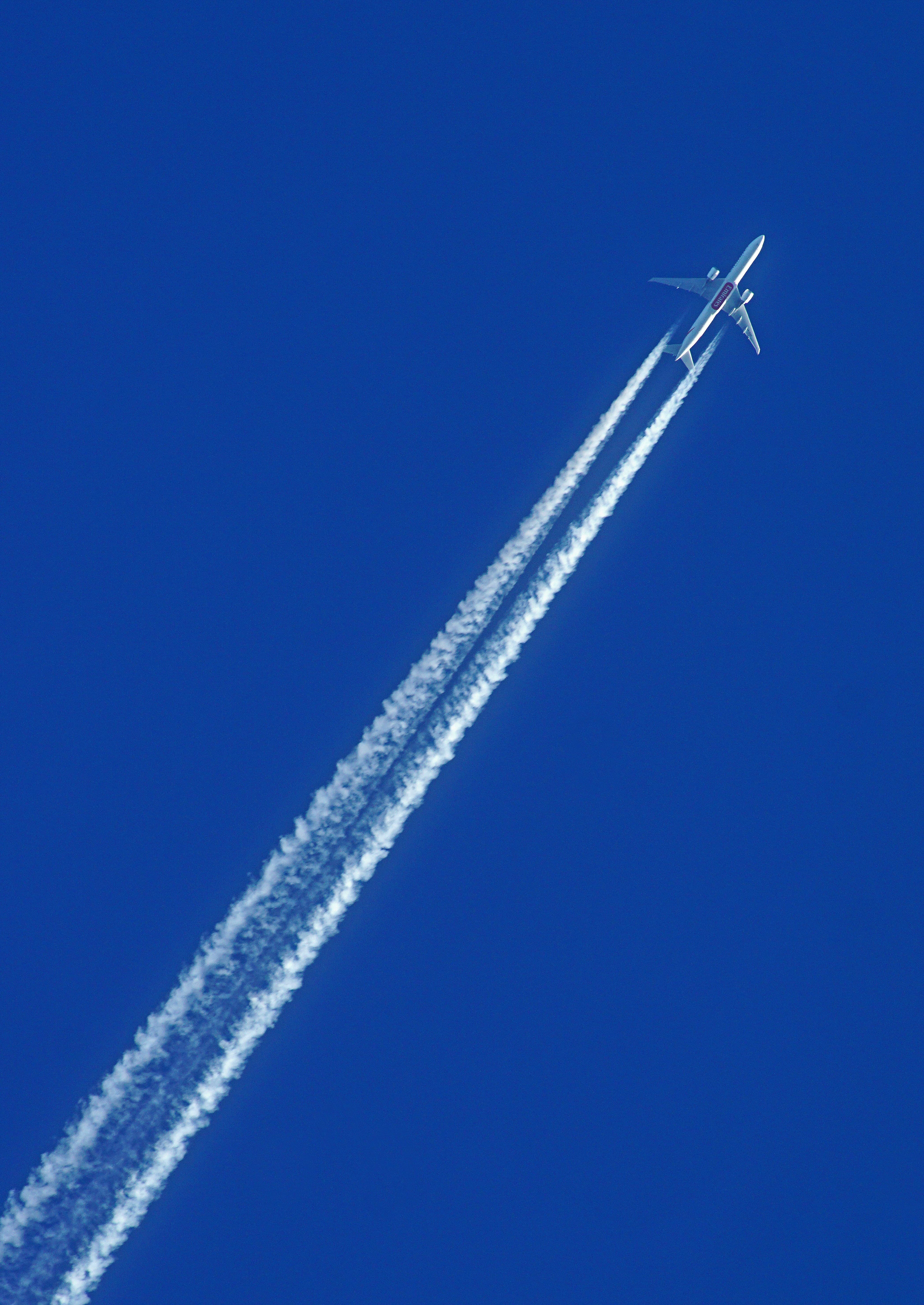
The Claim
The theory goes like this: the white trails left behind by airplanes aren't normal condensation. they're chemicals being deliberately sprayed into the atmosphere by the government, the military, or some unnamed entity. The alleged purposes range from weather modification to population control to mind-altering substances. The trails are said to linger too long, spread too wide, or appear in suspicious patterns that prove they can't be natural.
This theory has been around since the mid-1990s and has grown steadily online. According to a 2016 national poll of 1,000 Americans, published in Palgrave Communications, about 10 percent said the chemtrails conspiracy was "completely true" and another 20 to 30 percent called it "somewhat true." So let's look at what's actually happening up there.
What's Actually Happening
A jet engine burns fuel. That combustion produces several things: carbon dioxide, water vapor, and a small amount of soot particles. When this hot, moist exhaust hits the surrounding air, which at cruising altitude (around 30,000-40,000 feet) is typically between -40°F and -70°F. the water vapor freezes almost instantly into tiny ice crystals.
That's a contrail. Short for "condensation trail." It's the same basic process as seeing your breath on a cold morning, just at a much larger scale and a much colder temperature.
Key Fact
Contrails were first observed and documented during World War I, nearly 80 years before the "chemtrail" theory emerged. B-17 bomber crews in World War II were well aware of them. contrails gave away their position to enemy fighters.
Why Do Some Trails Last Longer Than Others?
This is the question that fuels most of the suspicion, and the answer is straightforward: humidity.
When the air at altitude is dry, ice crystals sublimate (turn back into invisible water vapor) quickly. The trail disappears in seconds. When the air is humid, meaning it's already close to saturation. the ice crystals persist, spread, and can last for hours. They can even spread into thin cirrus-like cloud sheets.
This is why you can watch two planes fly similar paths minutes apart and see one leave a short trail and the other leave a long one. They're flying through different layers of air with different humidity levels. This isn't suspicious. it's meteorology.
Key Fact
Weather forecasters actually use contrail persistence as a humidity indicator. Long-lasting contrails suggest high humidity at altitude, which often means weather changes are coming. This relationship has been documented in atmospheric science since the 1950s.
But What About Cloud Seeding?
Cloud seeding is real. It's a weather modification technique where silver iodide or other particles are released into clouds to encourage precipitation. Several states use it, the UAE uses it, China uses it extensively. It's not secret. it's published, regulated, and debated openly in scientific journals and government budgets.
But cloud seeding is done by small specialized aircraft flying into existing clouds at low altitude, not by commercial jets at 35,000 feet. The delivery method, altitude, scale, and purpose are completely different from what the chemtrail theory describes. Pointing to cloud seeding as proof of chemtrails is like pointing to crop dusting as proof that all planes are spraying pesticides.
What Would It Actually Take?
Consider the logistics. There are roughly 45,000 commercial flights per day in the United States alone. If chemicals were being added to jet fuel or sprayed through separate systems, it would require the cooperation of every airline, every fuel supplier, every aircraft maintenance crew, every airport ground team, and every aviation regulatory body across dozens of countries. all maintaining perfect secrecy, indefinitely.
It would also require that none of the thousands of atmospheric scientists worldwide. people whose literal job is measuring what's in the air. had detected anything unusual. Air monitoring stations across the country continuously sample the atmosphere. The EPA, state environmental agencies, and university research stations measure particulate matter, ozone, sulfur dioxide, nitrogen dioxide, and dozens of other compounds around the clock. If something were being systematically sprayed into the atmosphere, it would show up in the data. It hasn't.
Key Fact
A 2016 peer-reviewed study from the University of California, Irvine, surveyed 77 atmospheric scientists and geochemists. Seventy-six of them said they had found no evidence of a secret spraying program. The one dissenter cited a single water sample with unexpectedly high barium levels, which was consistent with naturalite sources in that area.
So Why Do People Believe It?
This isn't a question we're going to answer with condescension. Distrust of government and industry on environmental issues is not irrational. Governments have conducted secret atmospheric tests. the U.S. military sprayed zinc cadmium sulfide over American cities in the 1950s and '60s as part of Cold War germ warfare research. The Tuskegee syphilis study happened. Agent Orange happened. The history of institutions lying about environmental and public health risks is real and documented.
So when people see something in the sky they can't explain, and they don't trust the institutions that could explain it, the gap gets filled with theory. The solution isn't to mock the question. It's to answer it clearly, honestly, and with the data, which is what the data supports: contrails are ice, the science is old, and the conspiracy would require a level of coordination and secrecy that doesn't survive contact with reality.
The Bottom Line
Contrails are condensation. They've been observed for over a century. Their persistence varies with humidity. Cloud seeding is a separate, real, publicly documented practice. No air monitoring data from any station, anywhere, supports the existence of a secret atmospheric spraying program. If new evidence emerges, we'll update this page. That's how this works.
Sources: EPA ambient air monitoring data; Shearer et al., "Quantifying expert consensus against the existence of a secret large-scale atmospheric spraying program," Environmental Research Letters (2016); NASA contrail education resources; NOAA atmospheric science reports; FAA aviation data. Have a correction or a source we missed? Contact us.