What Did They Find?
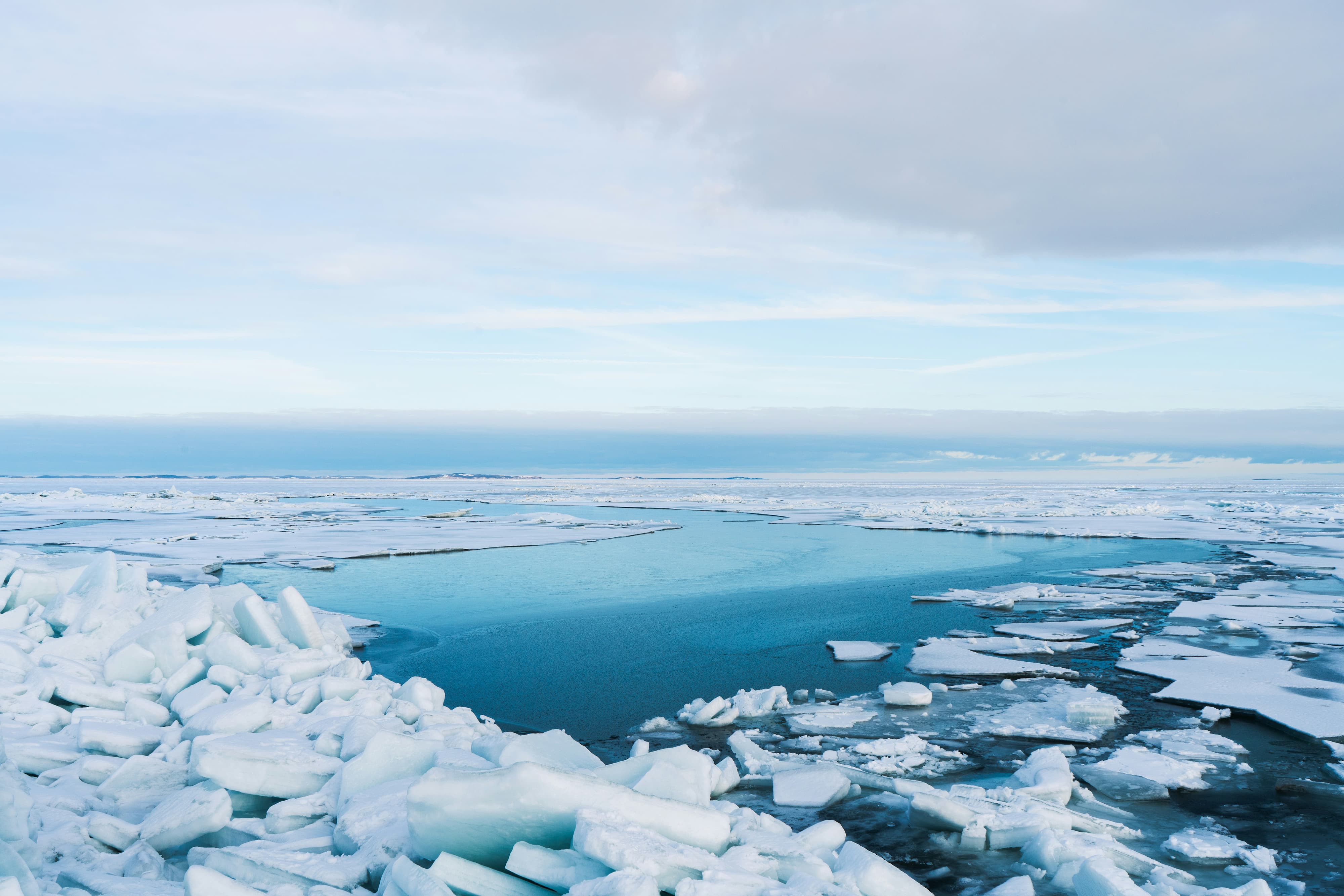
When Arctic sea ice melts in summer, water pools on top of the ice. These pools, called melt ponds, are shallow, low-salinity puddles made of melted snow and ice. They can cover large areas of the ice surface.
According to the study, those melt ponds contain high concentrations of biological particles called ice nucleating particles (INPs). These are tiny bits of organic material, likely proteins and fragments from microorganisms that live in the ice and snow. When they float into the air, they give water vapor something to freeze onto, which is one of the key steps in cloud formation.
The researchers found that meltwater contained roughly 10 times more of these particles than the seawater underneath. And the particles in the meltwater were overwhelmingly biological in origin, not dust or mineral-based.
What is an ice nucleating particle?
Clouds aren't just water vapor floating around. For a cloud droplet to freeze into an ice crystal, it usually needs a surface to freeze onto, like a tiny speck of dust, a grain of pollen, or a fragment of a microbe. That speck is called an ice nucleating particle, or INP. Without INPs, water droplets in clouds can stay liquid well below freezing. The type of INP matters: biological ones (from living things) can trigger freezing at relatively warm temperatures, around 14°F (-10°C), while mineral dust typically needs much colder conditions.
Why Does This Matter for Climate?
Arctic clouds play an outsized role in the region's climate. Whether a cloud is made of liquid droplets or ice crystals changes how much heat it traps and how much sunlight it reflects. According to the study's authors, the ratio of liquid to ice in Arctic clouds is one of the key factors controlling how much radiation reaches the surface below.
According to lead author Camille Mavis, a doctoral student at Colorado State, current climate models don't do a good job of simulating Arctic clouds. "Clouds are complex, and there is still a lot of uncertainty associated with how aerosol interactions affect cloud radiative effects overall," Mavis told Colorado State's press office. "Our current models don't do a good job of mimicking these clouds right now, especially in polar regions."
If melting ice is pumping biological cloud-seeding particles into the atmosphere, and if that process gets stronger as melt seasons get longer, then models that don't account for it could be getting the Arctic's future climate wrong.
The feedback loop
Here's the cycle the researchers are concerned about: the Arctic warms, which means more ice melts, which means more melt ponds form on the surface. Those ponds release more biological particles into the air. Those particles change how clouds form. Changed clouds alter how much heat the Arctic absorbs or reflects, which affects how fast the ice melts. And the cycle continues. According to a 2022 study in Communications Earth & Environment, the Arctic is warming nearly four times faster than the global average, which makes even small feedback mechanisms potentially significant.
How Did They Collect the Samples?
The samples came from the MOSAiC Expedition, one of the largest Arctic research missions ever conducted. In 2019-2020, the German icebreaker Polarstern intentionally froze itself into the Arctic pack ice near the North Pole and drifted with it for an entire year, from October through August. Scientists from 20 countries collected data on the atmosphere, ice, ocean, and ecosystem.
According to the study, the team collected nine meltwater samples from ponds and one open lead (a crack in the ice) during July 2020. They also collected seawater samples, ice cores, snow, and air filters placed both on the ice surface (1 meter high) and on the ship (15 meters high). By comparing INP concentrations across all these samples, they could trace where the particles were coming from.
The air filters placed close to the ice surface, downwind of melt ponds, showed higher concentrations of warm-temperature biological INPs than the filters on the ship 15 meters up. According to the study, this suggests the melting ice surface itself is the source, not the open ocean.
What Don't We Know Yet?
The study establishes that melt ponds contain these particles and that they show up in the air nearby. But several important questions remain open.
According to senior author Jessie Creamean, a research scientist at Colorado State who traveled on the MOSAiC expedition, the team doesn't yet fully understand how the particles get from the water surface into the air. "The clouds in the Arctic are different than you would find in the Pacific or Atlantic. They behave differently despite having some of the same general materials and processes," Creamean told Colorado State's press office. "That is part of the reason we want to understand how they are formed there, because each region is unique in this small but important process."
The researchers think bubbles are involved: as ice melts, it can release trapped gases, and microbes in the meltwater can produce gas through respiration and photosynthesis. When those bubbles burst at the surface, they could fling biological material into the air. But according to the study, this mechanism hasn't been directly measured in melt ponds yet.
The sample size was also small: nine meltwater samples and 11 air filters from a single July. The researchers are clear that more observations across more seasons and locations are needed before anyone can say how big a role this process plays.
The bottom line
Melting Arctic ice isn't just a consequence of warming. It may be actively changing the atmosphere above it in ways we're only beginning to measure. The melt ponds that form on sea ice each summer contain biological particles that can seed cloud formation, and those particles are far more concentrated in meltwater than in the ocean below. As the Arctic continues warming faster than the rest of the planet and melt seasons grow longer, this process could become increasingly important for the region's climate. Climate models that don't account for it may be missing a piece of the puzzle.
Sources: Mavis, C. E., et al. (2026). "Meltwater as a Local Source of Ice Nucleating Particles in the Central Arctic Summer." Geophysical Research Letters, 53, e2025GL118445 (open access); Colorado State University press release (April 13, 2026); Rantanen, M. et al. (2022). "The Arctic has warmed nearly four times faster than the globe since 1979." Communications Earth & Environment; MOSAiC Expedition. Have a correction? Contact us.